
In the blink of an eye, traveling tykes turn into traveling teens. As teens become more independent and have their own activities and interests, many of them begin to have reasons to travel by plane solo - often starting well before they are legal adults at age 18.
Whether your teen needs to fly to a summer camp or internship, to visit family, or for any number of other reasons, the process of preparing a teen for a truly solo trip can be a little intimidating. How do you know if your teen is ready to fly alone? What are the special requirements you need to consider and prepare for with different airlines? What if something goes wrong like a flight cancellation or missed connection?

My oldest child who is almost 17 has flown on multiple occasions by herself, including on an international trip to visit family in Mexico. As a result, I've planned for, researched, and experienced the rules of multiple airlines. We've also navigated the special regulations and considerations of a border crossing experience.
If you are considering letting your teen fly truly solo - without an accompanying adult or the assistance of an airline's unaccompanied minor program - here is everything you need to know and prepare.
Is your teen ready to travel solo?

Before planning a trip, it's of course essential to know whether your teen is ready to fly solo. Are they navigating their neighborhood or city independently already? Are they experienced frequent flyers from your earlier family travels? Could they realistically handle a major trip disruption? Are they comfortable with the idea of going at it alone and excited to take on the challenge?
A lot depends on the kid, but a lot also depends on the trip. Different trips can have very different levels of difficulty. Travel time, whether a connection is involved, and what airports your teen is passing through and their familiarity with them all play a role.
My kids both flew as unaccompanied minors on Southwest from OAK to BUR when they were in elementary school to visit their uncle. So I would have been very comfortable with them taking that same trip, for example, a few years later solo even at age 12 - the earliest age they could travel solo without assistance on Southwest. The trip is just a 1 hour short nonstop flight between the Bay Area and Southern California. And it's in and out of two smaller airports on an airline they've flown hundreds of times - definitely a no brainer.
That said, my younger child is currently 12 years old, and I don't think he's quite ready to do a more complicated trip totally by himself yet, such as one that requires changing planes in a major airport he doesn't know well. My fiercely independent first born kid? She probably could have done that in a pinch even at 12 - but certainly by 13 or 14.
The bottom line? Consider both the kid and the logistics of the trip involved before you take the plunge and book a solo trip for your teen.
Airlines have different age minimums for solo teen travel.

Assuming your teen is ready for their first solo trip, it's also vital to know whether they are even able to fly alone on a particular airline before you book. Age cutoffs for teens traveling solo (often called "Young Travelers") vary considerably airline to airline.
All U.S. carriers allow teens to fly without adult supervision somewhere between the ages of 12 and 15 for domestic travel. Some also make their unaccompanied minor service (where airline employees will provide some supervision and assistance for a fee) optionally available for older teens as well. Once kids reach a certain age, however, they will age completely out of being able to use any unaccompanied minor services, even optionally.
At 12, Southwest Airlines has the youngest age when minors can fly completely solo domestically. Southwest is closely followed by Alaska/Hawaiian and small low cost carrier Breeze which permit 13 year olds to travel alone on some flights. Legacy carriers like United, American, and Delta all make teens wait to fly alone until age 15, but also have a much larger geographical reach with more complicated itineraries offered.
Here are the ages for each and every U.S. airline when teens can travel solo without the assistance of unaccompanied minor supervision, along with a link to the airline's official policy so you can verify that the rules haven't changed before your trip:
- Alaska (including Hawaiian): 13+ (Optional UM service available for teens ages 13-17).
- Allegiant: 15+
- American: 15+ (Optional UM service available for teens ages 15-17).
- Avelo: 15+
- Breeze: 13+ (on nonstop domestic flights only), 18+ on connecting or international flights.
- Delta: 15+ (Optional UM service available for teens ages 15-17).
- Frontier: 15+
- JetBlue: 14+
- JSX: 14+
- Southwest: 12+ (on domestic flights only; no overnight connections permitted), 18+ on international.
- Spirit: 15+
- Sun Country: 15+ (on domestic flights only)
- United: 15+ (Optional UM service available for teens ages 15-17).
Foreign carriers may have different rules, including a few airlines that simply don't take travelers under 18 flying solo at all.
Note also that if your teen is traveling with and supervising younger kids such as siblings, you need to consult the unaccompanied minor rules of the airline. Some permit kids/teens as young as 12 to act as an "adult" supervising younger kids, but others won't allow a teen to travel with younger kids not old enough to travel solo themselves until they turn 18.
Some airlines don't permit teens under 18 to fly solo internationally.

While the rules are pretty straightforward for teens traveling domestically, if you are planning a more ambitious trip that involves international travel, things can get even more complicated and confusing.
A few U.S. airlines - and some foreign carriers - simply won't let teens under the age of 18 fly without an adult on international flights at all. Some permit international flights, but only to limited destinations or on a limited selection of flight times. You really do have to read all of the fine print of an airline's website (and sometimes even call for clarification) before you book.
We bumped up against this issue when we sent my 16 year old daughter last summer to visit for several weeks with my sister-in-law's family in Mexico. My husband flew down there with her to get her settled, but we planned to have her return solo. Southwest, for example, would not have been an option at all from any destination in Mexico because it doesn't permit teens to travel internationally by themselves until they turn 18.
Thankfully, Mexico's largest low cost airline Volaris had no similar requirement (it allows teens 13+ to fly solo even internationally as long as they are accompanied to the ticket counter and checked in by an adult age 18+). The airline also flies an easy non-stop route between our hometown airport and the closest major airport to the city in Mexico where family lived, making the trip possible.
Your teen needs an ID.

Another thing to plan for well in advance of a teen's solo trip is proper identification. What ID works? If they are traveling internationally, only a passport will do, of course. But for domestic travel, different airlines have different rules. It all can get confusing quickly.
Related: Does my Child Need ID to Fly
Teens under 18 technically don't need ID to get through TSA checkpoints to fly within the United States unless they are using TSA Pre-Check lanes (see TSA's official rules here). But that doesn't mean your teen can fly solo without an ID. Many airlines will separately require identification of some sort for solo teens.
A few airlines are as strict with teens as they are with adults and require an official government-issued photo ID like a drivers license or passport. A few airlines (like United pictured below), recognize that teens don't always have this kind of identification yet and expand the list of recommended options to include a school student ID or birth certificate.
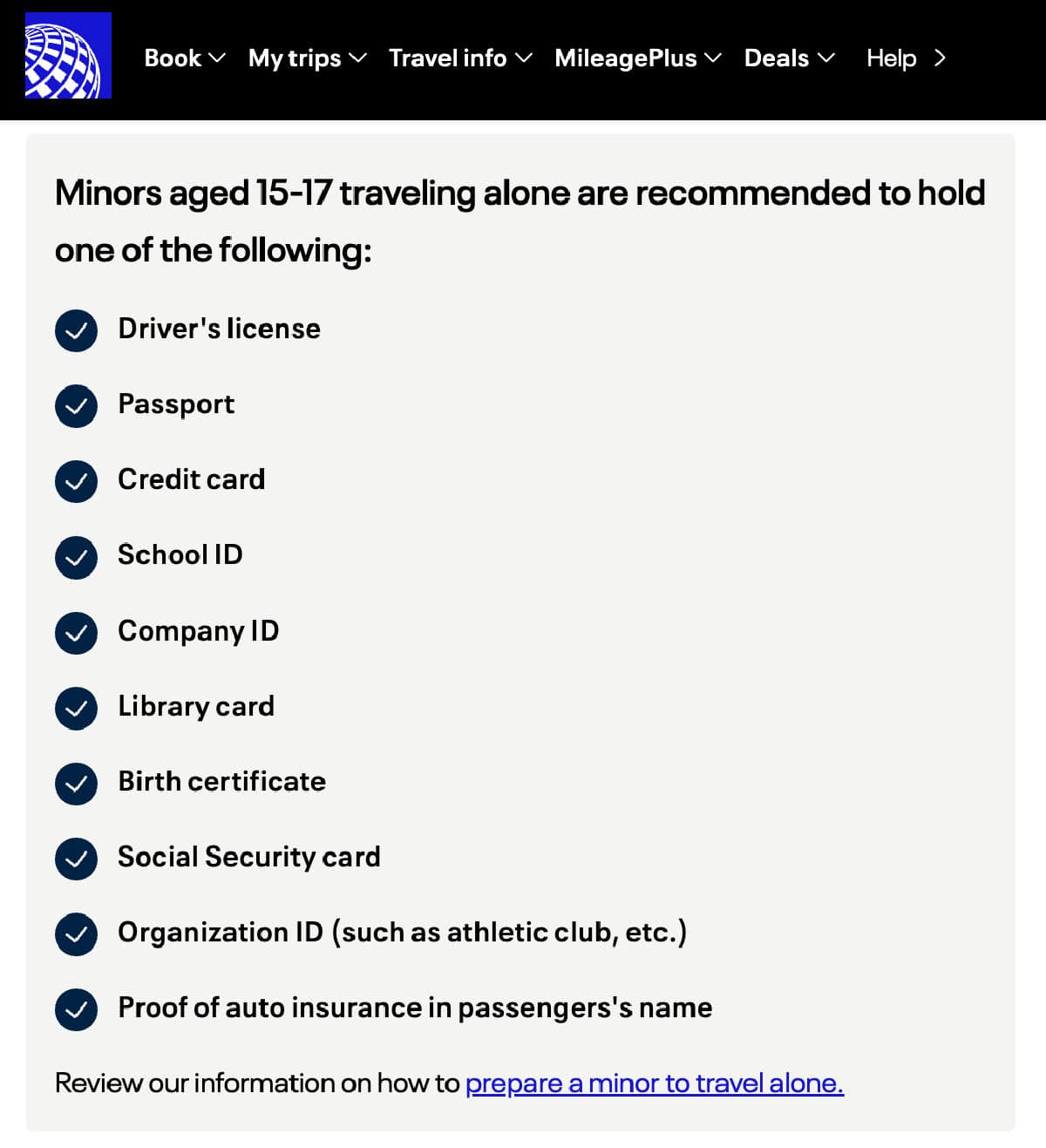
Personally, I wouldn't let my own teen chance it traveling solo with an ID that isn't Real ID compliant. I've had enough encounters with TSA and airline employees over the years misinterpreting their own official rules (like those that apply to flying with liquids or carseats) to know that it can be hard to try to navigate the air travel system as an exception. If your teen has a Real ID like a drivers license, the chances for hiccups are dramatically reduced.
But if your teen hasn't gotten a drivers license yet, make sure they have another form of Real ID on them. A passport is the easiest option and probably something a lot of teens already have if their family travels regularly. Alternatively, you could also get a state ID card at your local DMV if your teen doesn't have a passport or drivers license.
Teens may also need other documentation to travel.
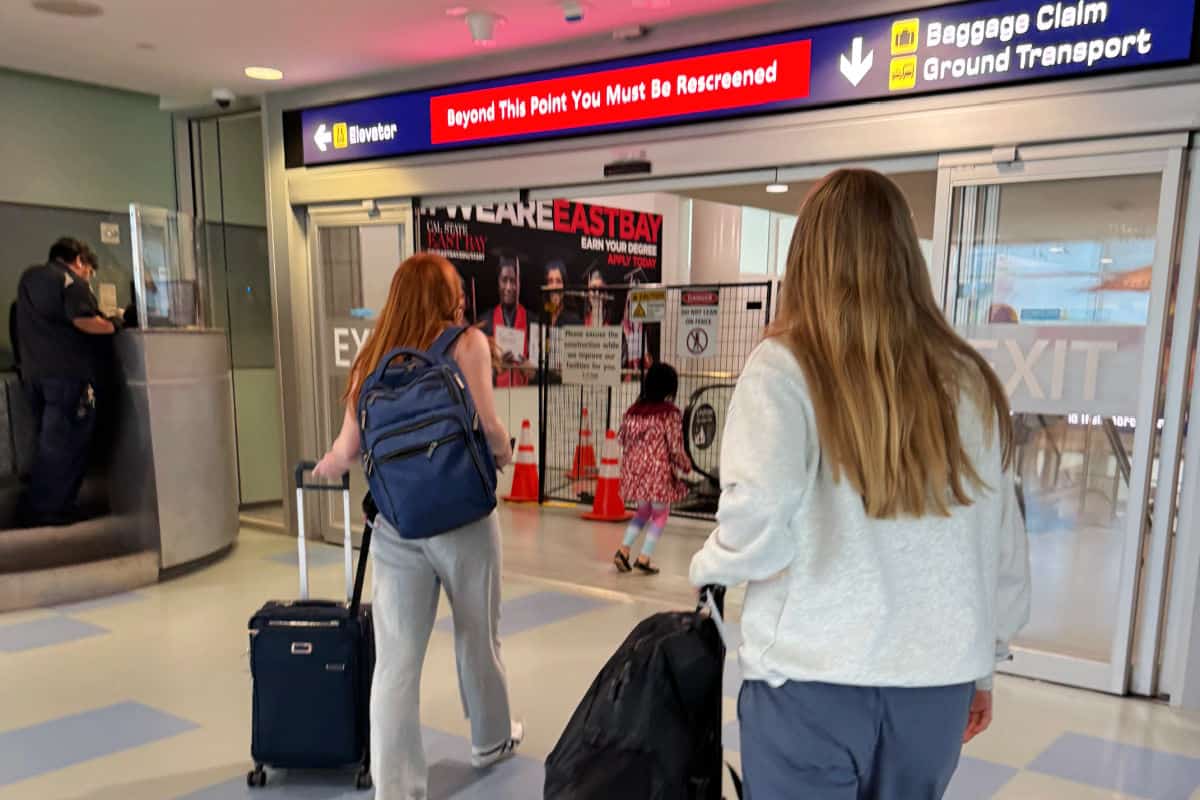
For domestic travel within the USA, an ID is likely all that is required for a teenager to travel solo. But for those airlines that do permit international travel, you may need additional documentation of some sort.
What else could possibly be required?
- ID for an accompanying adult: An airline may require an adult to check in a solo teenage traveler (as was the case for our daughter's flight on Volaris from Mexico). Make sure the accompanying adult has a proper ID like a passport.
- Notarized letter of consent to travel: Many countries require parental permission for a child under the age of 18 to travel any time they are without both parents - and this is particularly important when they are traveling solo. Check the border crossing requirements for the country your teen is visiting carefully. For my daughter's Mexico trip, my husband and I prepared a letter of consent that we both had signed and notarized. We also attached copies of our passports as well as her birth certificate to prove that she was our child.
- Visa or similar travel authorization: If your teen is traveling to a country where a visa is required for American visitors, be sure to complete those requirements meticulously as well. Remember that much of European travel will soon involve special semi-visa style requirements even for Americans. The United Kingdom has already rolled out its own Electronic Travel Authorization requirement for tourists, and much of the rest of Europe will soon have something similar (ETIAS, expected to launch in late 2026).
Consider digital tracking for safety.
While fostering independence in your teen is important, parents have to balance that interest with reasonable safety precautions as well. So before your teen travels solo, you may want to consider one or more options for keeping tabs on your teen digitally while they are en route.
At the very least, consider putting an Airtag in each and every bag that your teen is flying with - if only to be able to track down their luggage if the airline loses it or they inadvertently leave a bag somewhere.
Also make sure tracking features like "Find My" are fully enabled on their electronic devices like smartphones and computers.
A word of parenting advice: talk through any and all tracking with your teen first and come up with a plan together. I can't promise they still won't feel like you don't trust them or are trying to spy on them, but you can often get a little more buy in if you make the process collaborative. We added Life360, for example, when my daughter stayed in Mexico with extended family so we could have a few extra assurances that she was where she was supposed to be while far away from home.
Have a contingency plan for trip interruptions.

Despite all the best preparations, things can go awry when it comes to air travel. Delays can caused your teen to miss a connection. Or a flight might have to divert due to weather or another passenger's medical emergency. While it's not fun to think through worst case scenarios, you really should.
One of my most formative experiences as a teen happened when I was 17 and traveling solo. I had been in Europe with a student travel group but was traveling separately from the group on two domestic flights after returning with them from overseas into Newark. The first of those domestic flights to Atlanta was delayed, causing me to miss the last connecting flight of the night to my final destination. I found myself stranded in Atlanta overnight during the 1996 Olympics on what turned out to be the night of the bombing at Centennial Olympic Park. I can only imagine how terrified my parents were (especially as this was very much pre-cell phone era) but I managed to muddle through and have quite the story to tell to this day!
So how can you help your teen manage both the ordinary and extraordinary hurdles they may find in their way? I personally would recommend booking flights departing in the morning to build in some buffer for delays and missed connections. The earlier in the day your teen flies, the more alternatives they have to get a trip back on track the same day. Remember that teens won't be old enough in most instances to rent a hotel room if they are stranded overnight somewhere.
Book non-stop flights if at all possible, even if they are more expensive. If there is ever a time to splurge a bit on travel, it's in these couple of years.
If you have no choice but for your teen to take an itinerary with a connection, consider connecting in cities where friends or family live. That way if your teen misses a connection, they have somewhere to go and another friendly adult to help them through - particularly if they need to stay overnight.
Finally, make sure your teen has modern tools like a smartphone and a credit card so they can get ahead of and handle issues that arise (in my day, I had to use a calling card to get in touch with my parents, but that made all the difference as they were able to work some magic and secure me a hotel in Atlanta after I called them from Newark!).
Pack & prep thoughtfully.
Speaking of what tools your teen needs, it's important to make sure they have the right items packed for the trip, both for contingencies as well as for their comfort en route.
We've already covered items like cell phones, credit cards, and IDs, but also think about the logistics of their particular trip and what can help with that.
For example, if you have a younger teen, you may want to avoid sending them with a rollaboard carry on bag they might not be able to lift into an overhead bin or easily navigate through an airport by themselves. A backpack might be better.
All teens will also need items to keep them entertained and fed, so pack snacks and have them download movies to their device. Don't forget associated items like headphones and chargers with cords.
If they want to use WiFi on some airlines, they often will need to input their frequent flyer or reservation number, so make sure they know where they can access that. If they take any essential medicines, make sure those are packed in a carry on bag as well. It's also never a bad idea also for them to have some basic OTC meds like Tylenol or Pepto Bismol on hand.
packing list
What to Pack in a Carry On for Teens Flying Solo
- ID
- Letter of consent (if applicable)
- Smartphone
- Boarding pass (consider downloading the airline app and adding the pass to your teen's smartphone digital wallet)
- Portable charging brick + compatible cord
- Credit card
- Cash
- Airtags
- Headphones
- Snacks
- Pens & pencil
- Water bottle
- Hoodie
- Medicines
Additional Tips for Teens Flying Solo
A few final tips and things to be aware of that can help parents and traveling teens before a solo trip:
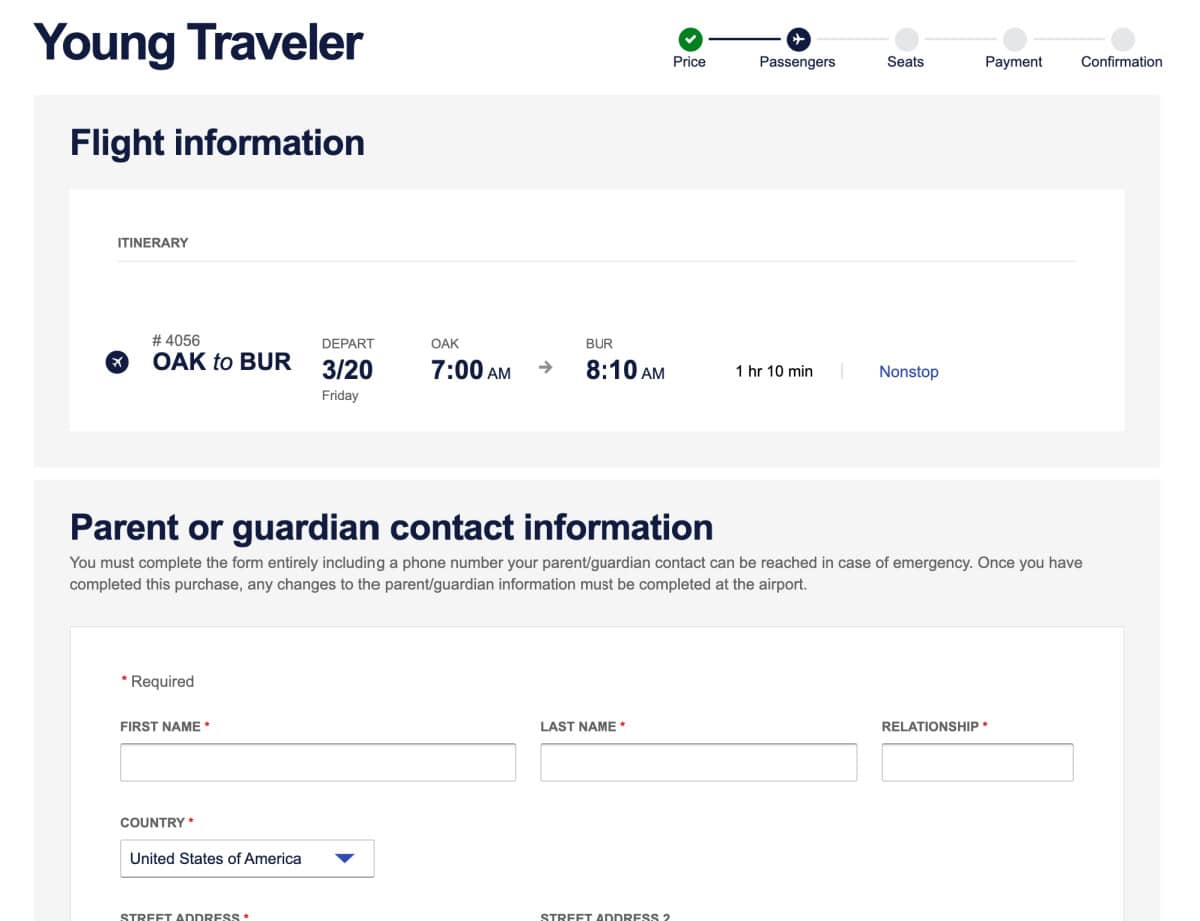
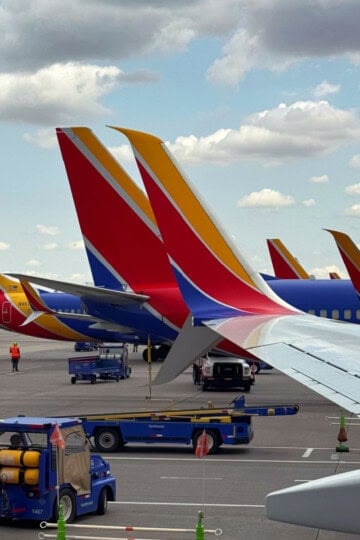
- Airlines may have extra requirements at booking for teenage travelers: Booking a trip for your traveling teen may involve a few extra steps with the airline. Some will only take these bookings over the phone, while others may require you to fill out extra paperwork. Southwest (pictured above), for example, allows flights to be booked online but prompts you to input the contact information of an adult before letting you book the trip.
- Teens may not be able to check-in online: Some airlines won't let you check a solo traveling teen in online in advance. That means you need to get to the airport early to check in at the ticket counter, even if your teen isn't checking a bag. Make sure you get there early enough to avoid any cut off times. Some airlines require that check in be complete a full hour in advance of a flight.
- Gate passes are usually available for domestic travel at departure: Most U.S. airlines will give parents and guardians a gate pass to accompany a teen through security to take them to the gate for a domestic flight. Leave extra time to go to the ticket counter if you want to utilize this option. Be aware that you won't be able to use TSA Pre-Check yourself with a gate pass. Gate passes at arrival airports are less commonly granted.
- Consider TSA Pre-Check: If your teen plans to go through airport security on their own, I highly recommend that you get TSA Pre-Check (or Global Entry which includes Pre-Check) for them so they have a lower stress start to their trip with shorter lines. Be sure to add their known traveler number to the booking and also double-check the TSA Pre-Check logo actually appears on their boarding pass after you check-in.
Related: Expert Tips for Speeding Through Airport Security
H/T to Shawn Coomer of Miles to Memories and the original traveling teenager John Ryan for their assistance and advice when I planned for my teen's Mexico travel.

Leave a Reply